
Infections related to toenail fungus are fairly common conditions that affect approximately 10% of the American population. The fungus that invades your nail is a living organism that thrives in dark, damp conditions. While the fungus has the potential to occur in the fingernail, it is far more common in the toes because of the desirable environment of the foot. This fungus can live along side the nail, or under the nail; however, this may depend on many factors such as the progression or severity of the condition.
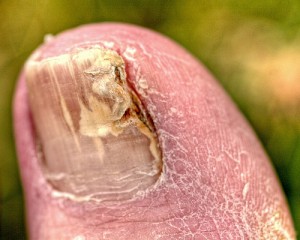
Many doctors have noted that in the beginning stages of this condition it is common for the fungus to live along side the toenail, and if left untreated slowly progress inward, or under the nail. Some symptoms at the beginning of this fungal infection include a white or yellowish spot on the nail; it is not a common occurrence to have pain at this stage of the infection. It is this lack of pain that often causes this symptom to be overlooked, therefore allowing the infection to progress.
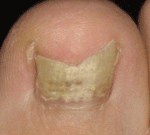
The next stage of the infection is a bit more noticeable, although it can occur rather slowly. At first you may notice a dullness followed by a yellowing, and your toenail may actually change shape. This change in the shape of your toenail may actually be caused by the thickening and/or crumbling of the edges that occurs. This thick yellowing of the nail is often the trademark of the condition. At this stage of the infection most people experience some degree of discomfort, this may be associated to the fact that the toenail can actually separate from the nail bed.
When the condition progresses enough to result in a separation of the nail and the skin, exposing the nail bed, this can result in a serious infection. If you notice a foul odor, or pus oozing from the toe, it is imperative that you seek medical intervention to prevent a serious infection.
A common misconception is that the micro-organism that causes this infection is rare and only found in dirty places. This micro organism is not bias, if there is a warm damp environment to be found, than you can bet that there are spores there waiting to be picked up on some ones hands or feet. This interaction between you and the fungus usually takes place on a daily basis, the problem occurs when you give the fungus a desirable environment to live in.
The fungus that usually causes these infections is known in the medical community as dermatophytes. There are other causes of fungal nail infections such as yeast and mold however, dermatophytes are the most common cause. Certain factors may make an individual more susceptible to toenail fungus. These factors include:
- A malfunctioning immune system
- Peripheral artery disease
- Trauma to the foot that includes the toenail
- Abnormal skin PH
- Poor hygiene
- Previous fungal infections of the nails
Fungal infections of the nails are not life threatening or debilitating. However, these infections can become painful and affect self esteem, due to the appearance of the nail. Because toenail fungus can be difficult to treat, prevention is of the utmost importance. If you have concerns that you may have a toenail fungus contact your doctor, he or she can examine your toes and run some tests to give you a definite diagnosis.
Click Here For Highest Rated Nail Fungus Treatments
1. Funginix - www.Funginix.com
2. Zetaclear - www.Zetaclear.com
3. PurNail - www.Purnail.com
Imad Nadir says:
I hve bad nail probelm. Nead help me
Jackie Siegel says:
I have just recently discovered myself to have toenail fungus. I go to water aerobics twice a week so I picked it up in the shower room. No one else seems to be complaining of symptoms; my immune system must be low. Mine has been painful so I’m either in the first stage or just going into the next one.
I learned that it was a fungus when I had a pedicure. There was a lot of jabbering in Korean between the two women that were doing pedicures next to one another and I wondered what was wrong with my nails that was causing such a stir. It was finally explained to me when I lost quite a bit of nail in my big toe and some of the nail next to it. She did what she could for me. She told me that it was either the aging process or I, indeed had a fungus. I’m 66. I’ll visit the doctor soon.
My questions are, if you are answering any, are:
How can I prevent spreading it to other family members? I share a shower with them and am concerned about passing it on to to others
I never really took the time to properly dry my feet after aerobics. I just dried them as best I could along with my knock off crocs and left in a hurry trying to catch a ride with someone so I presume that was a problem. I live in a very dry climate here in Colorado so I don’t have to worry about that. The only serious humidity I have encountered is the pool and shower/dressing room. Should I notify the center where I go to water aerobics that there is a fungus either in the pool or the shower/dressing room?
How long does it take to get rid of this stuff once treatment has begun?
My toes have been so sore since I had the pedicure; I was grateful that I learned that I had a fungus but I read that putting on toenail polish prohibits getting rid of the microbe. Is this true? I was going to make sure I had a monthly pedicure as part of the treatment but not if polishing the nails keeps it from going away. thank you so much for your informative web site and thank you for taking the time to answer my questions
Jackie Siegel
Sheree says:
Jackie,
What I found wrong with your statement is that your “Korean” Nail Tech, was trying to treat your nail as best she could. By state law, once she noticed or even suspected a fungus she was to stop the pedicure at that moment and explain to you that you need to see a Dr. She has contaminated her polish she used on you and in turn she used that polish on another, get the picture? She is not licensed to cure or treat your nails for this condition, no more than she is licensed to treat any other contageous condition. This fungus is a disease that is called tinea unguium , also known as ringworm of the nail,Tinea Pedis is athelete’s foot and if the nail techs did not sanitize properly between pedicures properly, all the clients that frequent that establishment is taking a chance of getting cross contamination. The nail tech is suposed to be trained to recognize the disease but not cure or treat it. that is the Dr’s job. There is no state in the union that will allow a nail tech to treat a nail condition like that. So in reality you may have gotten that anywhere not necessarily at the gym, but I would investigate their sanitation practices for both places, and good luck
Julie says:
Hi Jackie
6 years ago I went for a pedicure at a new place because
it was closer to my house, it was new years eve and I regret it…
My toe nails were painted dark red and about a month later when I removed
the polish, I had a fungal infection.
There isn’t ANY doubt in my mind that I got it from the nail salon myself…
I still battle with it…I did have the nail tested and it IS a fungus…I opted
not to take the oral medication the doctor offered due to the potential damage
that the liver could endure…scared me..
There are some home remedies and topical things you can use..but you have to
be really consistent and careful about socks etc..to get rid of it..
I, too, was concerned about passing it to others sharing shower etc..
I resolved my fears by just spraying bleach all over the tub after I used it.
Good Luck…remember…fungus lives in warm, moist areas…so deprivation of these
environments are essential..
leparparatrooper says:
I treat my nail fungus by clipping the affected nail completely out,
where the nail has separated, and rub menthol generously into my toenails
and around my toes. It doesn’t cure the fungus, but it does slow
it down and temporarily rids my toenails of that fungal look. I have
yet to try Penlac or Zetaclear.
leparparatrooper says:
Oops…I forgot to say that I wear socks after treating my toenails
with menthol to be certain the stuff soaks in.
Anonymous says:
I’ve been noticing that every time I take off my toe nail polish my nails looks very yellow and I thought it might be just stained from the polish. I’m pretty sure, after reading this post, its nail fungus. I better start treating it now before my toes look like the pics above lol. Thanks
Adrianne Nissila says:
Nice post. I was checking continuously this website and I’m impressed! Extremely useful info especially the last part I care for such info much. I was looking for this specific info for a long time. Thankyou and best of luck.